What to Check Before Buying an Electric Kettle
We may earn a commission when you buy through links on this page, at no extra cost to you. How we are funded.
The short answer
Start with your usual fill, then compare the lid, water-level indicator and filter. Aigostar, Breville Bold VKT221 and Russell Hobbs each list a 1.7-litre option, so maximum capacity alone does little to separate this shortlist. Their useful listed differences are the body construction, filling controls and power ratings. This is a comparison of retailer information, without hands-on boiling or pouring tests.


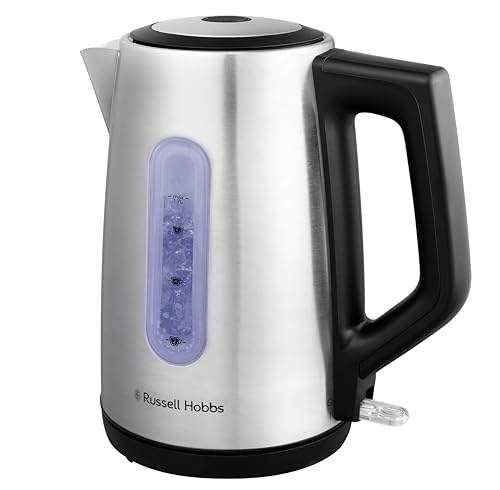
Choose a capacity around your usual fill
The Aigostar glass kettle, Breville Bold VKT221 and Russell Hobbs silver kettle are all listed at 1.7 litres. Treat that as their nominal maximum, rather than translating it into a universal cup count. A mug, teacup and recipe can call for different amounts of water.
Work out the quantity you normally heat and compare it with the exact model's minimum and maximum fill instructions. For smaller fills, the minimum permitted level is the detail to resolve before buying. Energy Saving Trust's appliance guidance advises avoiding overfilling kettles. Use that principle alongside the model's instructions; no model-specific savings figure is supplied here.
Compare the body, lid and water-level controls
| Check | Aigostar | Breville Bold VKT221 | Russell Hobbs silver |
|---|---|---|---|
| Listed capacity | 1.7 litres | 1.7 litres | 1.7 litres |
| Stated power | 2200W | 3kW | 3000W |
| Construction wording | Glass body and stainless-steel heating plate | Black finish with chrome accents | Stainless-steel body |
| Controls and care details | Automatic shut-off and boil-dry protection named | Central water window, lift-off lid and removable filter | Push-to-open lid, water gauge and washable filter |
If a glass body is part of your brief, investigate the listed Aigostar option. For a listed stainless-steel body, investigate Russell Hobbs. Breville's black-and-chrome wording describes the finish; ask for the exact interior material if that is a requirement. Keep the selected variant and model name with these checks so another colour or pack does not silently enter the comparison.
Check the filling method you will use
Breville lists a lift-off lid and a central water window. Russell Hobbs lists a push-to-open lid and a water gauge. Compare those opening arrangements with how you intend to fill the kettle, then inspect the exact instructions and product photographs for the location of the controls and fill markings.
Before ordering, answer three separate questions: how the lid opens, where you read the water level, and what minimum fill the instructions permit. A missing answer is a reason to request that detail, rather than infer it from the 1.7-litre headline. Handle feel and pouring behaviour would require a handling assessment; this guide supplies neither.
Read wattage without inventing a boiling result
Breville's 3kW and Russell Hobbs' 3000W express the same stated power rating. Aigostar's listing uses 2200W. Record those values separately from any boiling-time or running-cost comparison. The retained listings contain no shared trial using the same water quantity and starting conditions.
If boiling speed decides the purchase, look for a documented test of the exact model and check its fill volume and method before comparing results. If everyday quantity is the concern, resolve the minimum fill first. A higher wattage by itself supplies neither a model-specific energy saving nor a complete answer about the way you use the kettle.
Confirm the care and shut-off instructions
Breville describes its limescale filter as removable and cleanable; Russell Hobbs describes a removable washable filter. Check how the exact manufacturer's instructions handle filter removal and descaling before choosing between them. A removable filter is a maintenance feature, rather than evidence that deposits will never form.
Aigostar names automatic shut-off and boil-dry protection in its listing. If those controls are a purchase requirement, confirm them in the exact model documentation and read its warnings. For any of the three, collect the filling, operating and care instructions together before use.
Browse Electric Kettles if another model answers those requirements more clearly. Compare the exact option, current total offer and returns terms after resolving the practical details above.
Questions and answers
How do I compare three kettles with the same capacity?
Start with your usual water quantity and the exact minimum fill, then compare the lid-opening arrangement, water-level indicator and filter-care instructions. The shared 1.7-litre maximum does not decide those details.
Are 3kW and 3000W different power ratings?
No. Those two labels express the same stated power. They do not supply a timed boiling result or a model-specific running-cost comparison.
What should I check about a removable filter?
Find the exact manufacturer's removal and cleaning instructions, together with its separate descaling guidance. A filter description alone does not establish a deposit-prevention result.
Have these kettles been tested for this guide?
No. The table compares retained retailer information, and the linked Energy Saving Trust advice supplies general filling guidance. There is no hands-on boiling, pouring or electrical-protection test here.
How we compare
Sources and buying criteria
We use the product details linked below to compare specifications and explain the choices. We haven’t tested these products.
Check the selected model, compatibility and current offer on Amazon before ordering. Manufacturer performance claims remain claims, rather than our test findings.
Ready to choose?
Check the option that fits your needs
Confirm the size, quantity, delivery charge and returns terms with the retailer before you order. Your purchase is with the retailer.
